About Labels

If you would like to see all the pictures of one type of bird select the LABLE below.

NOW! Over 350 diffuerent birds! See the new Sandhill Crane colts

See travel notes

Our trip to Discovery Cove & Orlando, FL2016 is now posted

and more to come (Click photos to enlarge)


Showing posts with label *Toronto Zoo. Show all posts

Mar 26, 2012

Hornbill (Wrinkled)


Also known as Sunda Wrinkled Hornbill and found in forest in the Thai-Malay Peninsula, Sumatra and Borneo which is in S.E. Asia. Wrinkled Hornbills were first bred in captivity in 1988.

The Wrinkled Hornbill has a blue eye-ring, and a white or rufous-tipped tail.. Males have bright yellow feathers on the cheeks and throat but black on the female, except for the blue throat. The male’s bill is yellow with a red base and casque, and a brownish basal half of the lower mandible. The bill and casque of the female is almost entirely yellow.

The Wrinkled Hornbill eats mainly fruit, such as figs, although it will also eat frogs and insects. Wrinkled Hornbills do not drink, but get the water they need from their food.

These birds remain in a pair for life. They use holes found in trees for nests, and the female will plaster over the entrance with mud and droppings, leaving a nesting mother and chicks only a small hole, so they don’t exit and fed by the male. After several months, when the chicks are ready, the female will break out of her nest.

Photographed at Toronto Zoo, Toronto, ON

Feb 25, 2012

Cormorant (White-breasted)

Largest African Cormorant 85-95 cm, the White-breasted Cormorant is the only form of the Great Cormorant found in sub-Saharan Africa. A fish and frog eater with a white throat and breast - yellow at base of throat. The white-breasted cormorant is able to swallow larger than the normal diameter of its neck because a unique musculature of the neck allows it to stretch out.
 

The throat, or gular pouch, is also used as a signaling device and as a means for cooling the body. By panting and fluttering the gular pouch, blood passing through the rich concentration of capillaries is rapidly cooled.


Photographed at Toronto Zoo, Toronto, ON


Feb 11, 2012

Thrush (black throated laughing)


The male and the female of the Black-throated Laughing thrush have the same characteristic.

Can be found in Asia, south of China and Thailand. The Black-throated Laughing thrush eats insect and fruit in the forest for its food.

Likes to stay together in a small troop in dry forest more than tropical rain forest; for example, groove wood and sparse forest. It normally jumps back and forth to seek for the food on the ground and makes a noise all the time like a mocking bird. It is the bird that can sing beautifully and can mimic the voice of other bird. The Black-throated Laughing thrush breeds in Apri with the female laying 3 to 4 eggs each time.

Photographed at Toronto Zoo, Toronto, ON

Feb 8, 2012

Motmot (blue crowned)

A colourful near-passerine bird found in forests and woodlands of eastern Mexico and Central America

The motmot can move as quickly as a hummingbird warning off predators. their tail swings from side to side when they’re disturbed. Their long “racquet”-shaped tail feathers are bright blue and distracks their enemy.


Motmots feed on insects, crushing them in their bill. They round out this diet with fruit and seldom larger prey like lizards, frogs, and even mice. If the prey is too large to swallow whole, the birds may club it against a branch to kill it. Blue-crowned motmots have also been observed carrying inedible objects, probably in an attempt to court a mate.

The birds live by themselves or in pairs, never in flocks keeping to a feeding territory. Motmots dig elaborate nests below the ground, consisting of a large tunnel extending six feet into an earthen bank. Both male and female cooperate in nest building.

 photographed at the Toronto Zoo

Sep 23, 2011

Turaco (Violet)


Turacos are social birds, travelling in flocks of around ten to twelve individuals. Nests are built out of twigs. The female lays two eggs, which are incubated for approximately three weeks. The young Turacos are fully coloured by the time they are a year old

Violet Turacos are found in tropical savannas, wetlands, woodlands and forests of Africa.

Turacos are not strong fliers but they can run quickly through the branches. They are quite shy and try to stay out of sight in the dense canopy of the forest. Their diet consists of fruit, and they are quite partial to figs, but they will also eat leaves, buds, flowers, insects, snails and slugs.

Photographed at Toronto Zoo, Toronto, ON

Trumpeter (Grey-winged)

Grey-winged Trumpeters live in the Amazonian Basin in tropical forests nesting in hollow trees.They lay 3-4 white eggs that are incubated by all members of a group of five or more birds. When not breeding, the flocks may number 50 or more. Their food is insects and fruit, picked off the ground. They are weak fliersand prefer to run than fly.


Adult male has velvety black feathers on head, neck, and upper back and under parts. We can see violet and green gloss on some feathers on lower fore-neck. Inner wing feathers are grey, covering lower back and short tail. We can see pale Buffy tinge on back, between black and grey plumage. Pointed bill is pale yellowish to pale-blue-grey. Both sexes are similar, with male slightly larger than female.


Photographed at Toronto Zoo, Toronto, ON

Toucan (Green Aracari)


The smallest of the toucans, the green Aracari still possesses a large, vibrantly colored beak, which can reach up to four inches in length. The species is named for the green feathers covering its back, but males and females can be distinguished by different colors on the head and neck. Males have black feathers on the top, while female's crowns are reddish-brown.


In captivity, it is the most frequently bred Aracari and member of the toucan family and is the most popular as a tame hand fed pet. They require a large cage due to their active nature, and a high fruit diet. The cage also requires toys to prevent boredom. When all these requirements are met, the potential owner is rewarded with a loving companion bird for many years.


Photographed at Toronto Zoo, Toronto, ON

Sep 22, 2011

Tinamou (Elegant Crested)

Tinamou are non-migratory birds that have adapted themselves to a variety of habitats ranging from mountain slopes, tropical rain forests, and the grasslands of southern Mexico, Central American and extending in South America. Crested Tinamou is indigenous to grasslands of southern Uruguay and Argentina where they are hunted for sport and food.
Related to the ostrich and the emu, Tinamou are the closest living relative of the prehistoric flying bird. Males incubate the eggs and raise the young, and chicks leave the next almost immediately. Tinamou has no hind toe. They are not considered endangered and are listed as least Concern.
 
Photographed at Toronto Zoo, Toronto, ON


Thick-knee (Double-striped)

Although their name gives no clue as to what kind of animal they are, "double-striped thick-knee" describes these birds rather well. They are large desert birds---about 18 inches long---with black stripes along the tops of their eyebrows, and thick "knee" joints. What looks like their knees mid-way up their legs are actually their heels! They have long legs and weak wings and so prefer running to flying. When threatened, they lower their heads and hit the sand running!


Double-striped thick-knees are active mainly at night (they are nocturnal), a strategy that allows them to avoid the heat of the day. During the day they crouch on the ground, depending on their brown plumage to help them blend into their stony desert habitat. At dusk, thick-knees become active.

Photographed at Toronto Zoo, Toronto, ON

Tanager (White-lined)

Tanagers are found only in the New World. The white-lined tanagers inhabit the northern and eastern coastal regions of South America


The white-lined tanager moves about in pairs and contrary to other tanagers, seldom mix with different species. They appear to be quite shy and seldom spend time on perches out in the open. They are associated with the warbler species of the “Old World”; small, active songbirds noted for their song.

Before breeding time, they build a thick, deep cup nest from plant material and when available, animal hair. They breed from March to October producing two eggs ranging in colour from grayish-white to pale rufous with brown spots.


Photographed at Toronto Zoo, Toronto, ON

Penguin (African)

The African Penguin is the only penguin species that breeds in Africa, and found nowhere else.

At the Toronto Zoo, these birds are identified by their markings on the face and dots on the belly. They are also tagged on their wings.

They spend a great percentage of their lives at sea. They return on a regular basis to their breeding grounds on land and continue to return to these sites year after year. Time spent on land is for the few months,  required for their chicks to develop. Moulting occurs annually between November and January in South Africa and between April and May in Namibia when the penguins come ashore for about three weeks, long enough to moult. They fast during this period of time.

Photographed at Toronto Zoo


Tanager (Blue-grey)


Blue-gray tanagers belong to a large family of small, colourful tropical birds. Powder blue in color, the males and females look alike.


Blue-gray tanagers, unlike most other tropical birds, prefer semi-open habitat and can often be found near human development, even nesting near or on buildings.

They lay 1 to 3 mottled eggs, which the female incubates for 12 to 14 days. Both parents feed the chicks.

The tanager’s natural range is from southern Mexico through Central America and throughout northern South America. This species was introduced into southern Florida.


1 Photographed at Toronto Zoo, Toronto, ON


2 & 3 Photographed at Bird Kingdom, Niagara Falls, ON

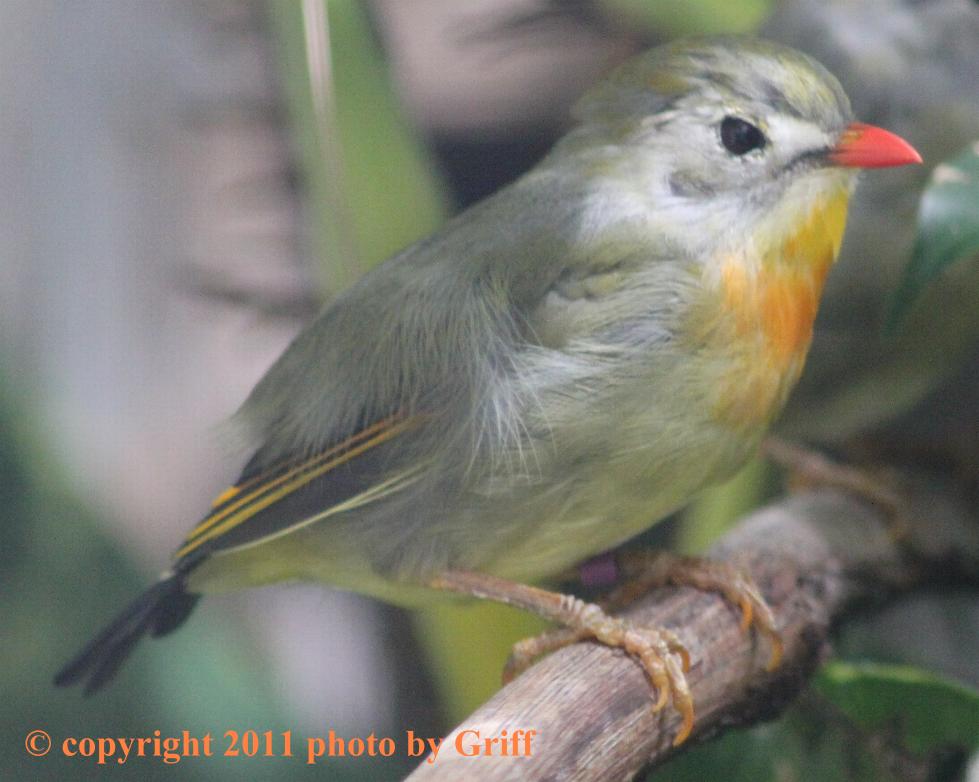
Robin (Pekin)

Pekin Robins are endangered due to events of avian influenza and import restrictions are controlled. Pekin Robins are no longer available in the pet trade and the birds imported from Asia prior to 1997 are now at the end of the average longevity and breeding potential.

The species is rapidly disappearing from aviaries outside South East Asia. Only concerted effort can keep this delightful species in our private or public aviaries.

Photographed at Toronto Zoo, Toronto, ON

Piping Guan (Blue-throated)

The Blue-throated Piping Guan is described as "oddly 'prehistoric' (reptilian)" but "handsome.

This species occurs in pairs during the breeding season and bigger groups, as many as 12, at other times. It walks nimbly or hops with help from its wings in the canopy or sub-canopy of the forest, especially in trees with flowers or fruit that it eats.

To cross-clearings, it sets off with fast wing beats and then glides, giving another flurry of wing beat if needed to maintain its height. Where not hunted it is fairly common and easy to see.


Photographed at Toronto Zoo, Toronto, ON

Pigeon (Victoria crowned)


Victoria Crowned Pigeons are the largest living pigeons, reaching lengths of between 28 and 30 inches from head to tail.


The Victoria Crowned Pigeon is very similar to the other Crowned Pigeons (see Blue Crowned Pigeon), but the barbs at the end of the crest feathers are only slightly separated and spatula-shaped. These dark blue crest feathers are broadly tipped with white. The general coloration is dark grayish blue. The breast is dark purplish red and the wing patch is pale grayish blue.

Victoria Crowned Pigeons to live up to 25 years in captivity and are known to be intelligent and quite easy to tame. Being docile by nature, they generally tolerate birds of other species quite well.


Photographed at Bird Kingdom, Niagara Falls, ON
and Toronto Zoo

Pheasant (Ringneck)

The Ring-necked Pheasant introduced into North America from Asia, has established over much of the continent, especially in agricultural lands. It is a distinctive and colourful species and is a popular game bird.

 In very bad weather, pheasants have been known to stay on a roost for several days without eating. These birds are most comfortable on the ground, where they forage for grains, seeds, berries, insects, and, occasionally, small animals. They can fly and launch themselves airborne with an abrupt, noisy takeoff, but typically run from trouble. Pheasant flights are merely short-distance dashes for cover.


Photographed at Toronto Zoo, Toronto, ON

Sep 21, 2011

Pelican (Pink-backed)


Pink-backed Pelican favours freshwater lakes and lagoons, open water in marshes, mangrove creeks, sheltered coastal waters. Pink-backed Pelican’s main food is fish and they fish generally in groups. Their beaks can hold up to 8 litres of water and fish.


Pink-baked Pelican nests in trees, near water, however, the trees die, due to the weight of the nests on their branches.

One of the world’s largest flying birds. They take off with difficulties, but once they are in flight, they fly well with few wing beats, alternating with glides. They fly with their heads pulled back over their chests. When flying in flock, they use a slanting line as a formation. They take turns to relieve the leader when it tires.

The chicks plunge their heads deep into the parental throat pouch to feed on partially digested fish.
 
Photographed at Toronto Zoo, Toronto, ON

Pelican (Great White)


Great White Pelicans reach lengths between 58 - 71 inches, they have a wingspan between 89 - 142 inches and they weigh between 11 - 33 lbs.

Great White Pelicans is found in the freshwater lakes, marshes, swamps and deltas of Africa, Asia and Eastern Europe. 

Great White Pelicans feed on fish, mainly carp and cichlids. They do not dive to catch their prey; instead, they dip their head underwater and scoop up fish. Several pelicans fish cooperatively where they move into a circle to concentrate the fish, then they dip their heads under simultaneously to catch fish.


photographed at Tornoto Zoo

Sep 20, 2011

Owl (Snowy)

One of the heaviest of North American owls, also known in North America as the Arctic Owl, Great White Owl or Harfang. The Snowy Owl is the official bird of Quebec.
 
A dense layer of down, overlaid with thick feathering, insulates the Snowy Owl’s entire body, including the legs and toes, and enables the bird to maintain a body temperature of 38 to 40°C, even when the air temperature reaches -50°C.
 
Although fast enough to capture ducks on the wing, the Snowy Owl prefers small mammals as prey. In the Arctic it may eat arctic hares, ptarmigan, foxes, or seabirds when available, but lemmings are its primary prey.

Photographed at Toronto Zoo, Toronto, ON

Turquoise Honeycreeper aka Blue Dacnis

This female Turquoise Honeycreeper, also called the Blue Dacnis, is a small tanager distributed throughout parts of Central American and tropical South America. It is generally in mating pairs or found even in mixed species flocks.

Blue Dacnis males are bright blue with a black throat, black above the bill and around the eyes, mostly black wings, and a black tail. The females are bright green with a bright blue head and blue shoulders. Both sexes have red eyes, reddish legs and feet, and a sharply pointed bill with a reddish base.


Photographed at Toronto Zoo, Toronto, ON