About Labels

If you would like to see all the pictures of one type of bird select the LABLE below.

NOW! Over 350 diffuerent birds! See the new Sandhill Crane colts

See travel notes

Our trip to Discovery Cove & Orlando, FL2016 is now posted

and more to come (Click photos to enlarge)


Showing posts with label *Kissimmee FL. Show all posts

Apr 3, 2016

Wren (Carolina)

The Carolina Wren creeps around vegetated areas and scoots up and down tree trunks in search of insects and fruit. It explores yards, garages, and woodpiles, sometimes nesting there. 

This wren often cocks its tail upward while foraging and holds it down when singing. Carolina Wrens defend their territories with constant singing; they aggressively scold and chase off intruders.

In summer it can seem that every patch of woods in the eastern United States rings with the rolling song of the Carolina Wren. This shy bird can be hard to see, but it delivers an amazing number of decibels for its size. Follow its teakettle-teakettle! and other piercing exclamations through backyard or forest, and you may be rewarded with glimpses of this bird's rich cinnamon plumage, white eyebrow stripe, and long, upward-cocked tail. This hardy bird has been wintering farther and farther north in recent decades.

Photographed in the wild, Kissimmee, FL

Mar 31, 2016

Warbler (Northern Parula)

A small warbler of the upper canopy, the Northern Parula can be found in two rather distinct populations. The southern population nests primarily in hanging Spanish moss, while the northern population uses the similar-looking old man's beard lichen. 

Pairs often return to same nesting site year after year. Males sing during migration and throughout nesting season, even when feeding young. Built solely by the female, but the male accompanies her on trips to the nest.
Pairs often return to same nesting site year after year. Males sing during migration and throughout nesting season, even when feeding young. Nest: Placed usually in a hollow excavated in hanging tree lichens (Usnea) or Spanish moss, 4-50' above the ground.


Photographed in the wild, Kissimmee, FL

Woodpecker (Pileated)

The Pileated woodpecker is about 15 inches in length and is the largest woodpeckers found in North America. Common in Ontario where I live, yet this is the first time I have seen or photographed...and it is in Florida.

It has a black body, a red crest, white stripes on its neck and black and white stripes on its face. It has yellow bristly feathers over its nostrils that keep out wood chips. It has a long, sticky tongue; a long, sharp pointed bill and yellow eyes. Males and females are similar, but males have a red forehead, and females have a gray to yellowish brown forehead. 

The pileated woodpecker lives in coniferous and deciduous forests in Canada from British Columbia east to Nova Scotia. It can be found in most areas of the eastern United States.

Photographed in the wild, Kissimmee, FL

Titmouse (Tufted)

This rather tame, active, crested little bird is common all year in eastern forests. It is related to the chickadees, and like them it readily comes to bird feeders, often carrying away sunflower seeds one at a time. Tufted Titmice look large among the small birds that come to feeders, an impression that comes from their large head and eye, thick neck, and full bodies. The pointed crest and stout bill help identify Feeders may be helping it to expand its range: in recent decades, Tufted Titmice have been steadily pushing north.

Besides gleaning trees and shrubs for arthropods, it spends more time on the ground searching leaf litter than do chickadees and most other titmouse species.

Photographed in the wild, Kissimmee, FL

Mar 30, 2016

Owl (Barred)

The Barred Owl’s hooting call, “Who cooks for you? Who cooks for you-all?” is a classic sound of old forests and treed swamps. But this attractive owl, with soulful brown eyes and brown-and-white-striped plumage, can also pass completely unnoticed as it flies noiselessly through the dense canopy or snoozes on a tree limb. Originally a bird of the east, during the twentieth century it spread through the Pacific Northwest and southward into California. 

The adult is 16–25 in long with a 38–49 in wingspan. Weight in this species is 1.10 to 2.31 lb. It has a pale face with dark rings around the eyes, a yellow beak and brown eyes. It is the only typical owl of the eastern Americas which has brown eyes; all others have yellow eyes. 

This Owl above is chasing a squirrel as you can see in the bottom of the pictures.

Photographed in the wild, Kissimmee, FL

Gnatcatcher (Blue-gray)

2010

Pronounced as “Nat-catcher” the tiny, long-tailed bird of deciduous forests and scrublands, the Blue-gray Gnatcatcher, resides in southern Ontario, the eastern and south western United States and Mexico.
2016

Adults are blue-grey on the upper parts with white under parts, with a long slender bill and a long black tail. They also have a white eye ring.

They build a cup nest similar in construction to a hummingbird nest made of spider webbing or caterpillar silk, covered with lichens or bark flakes. Lined with grass stems, bark strips, plant down, hair, feathers, or other fine fibers. Placed far out from trunk on tree limbs.. Both parents construct the nest and feed the young; they may raise two broods in a season. (Naples, FL) (Kissimmee, FL)

Mar 4, 2016

Crane (Sandhill)


Sandhill Cranes are big birds, with long legs and necks, long pointed beaks, and wingspans which can be over six feet. Adults are grey with red crowns. Juveniles are gray, washed with brown.

During the breeding season, the grey plumage of the adults is often stained brown with mud. Here the male does a typical mating dance to win her over. A "bustle", which covers the short tail, is composed of long, drooping inner wing feathers. (Kissimmee, FL March, 2011)

NEW  Photos  2016   Kissimmee FL
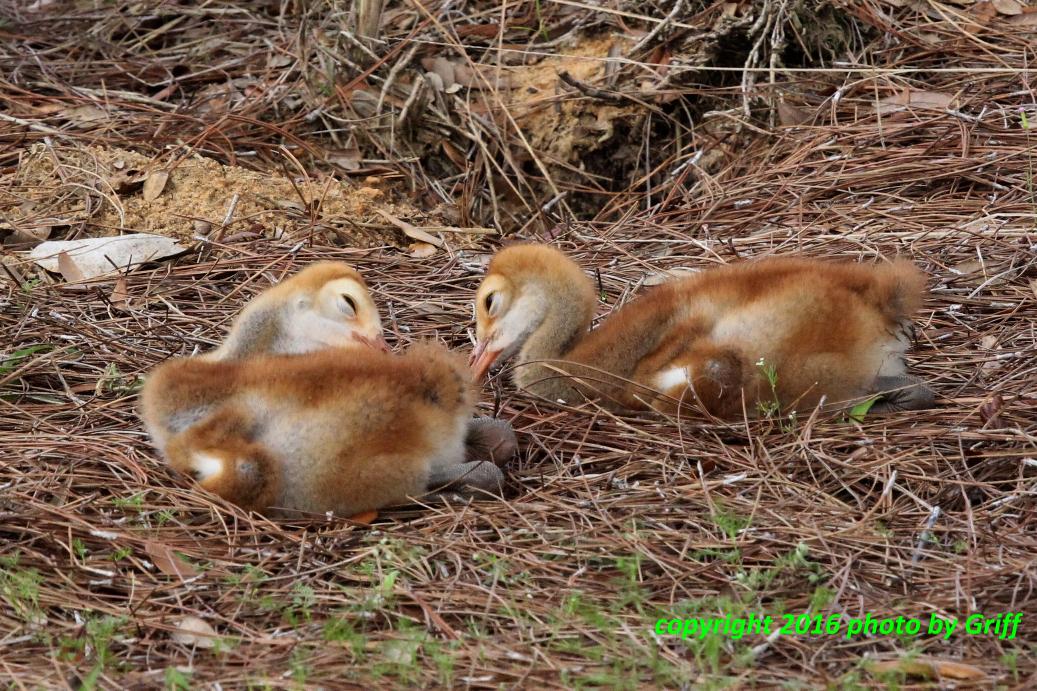
This year the pair of Adults have a couple of young ins of their own.
Baby sandhill cranes are called colts because of their long, strong, well-developed legs. A day after hatching, colts are already able to run after their parents. Although two eggs are usually laid, more often than not only one bird survives.


BUT these two are ready for action. The parents let me get about 12 feet away to take pictures freely as they grazed for food for the kids. Notice how they kind of sit on their knees while checking out their wings to be.
Like all youngsters they need their nap. these guys have been following Mom & Dad around 17th hole of a golf course. And yes they were chased off the greens by rude golfers. After a 3 minute nap its back in action.
Mar 1st, 2016
Click on the images to enlarge
 Mar 30th, 2016
This colt has survived its first month and is now ready to learn to FLY !

May 5, 2011

Hawk (Red Shoulder)


A common forest-dwelling hawk of the East and California, the Red-shouldered Hawk favors woodlands near water. It is perhaps the most vocal American hawk.

The Red-shouldered Hawk is a medium to large hawk measuring 15 to 19 inches in length and a wingspan of 3 to 3 ½ feet. Adults have a brown head and a red tinted chest. Their belly is pale in color with reddish bars.

Unlike most hawks, the Red-shouldered Hawk hunts from a low-lying perch. They sit quietly, waiting and watching, until prey wanders into their line of sight. Once spotted, the prey doesn't have a prayer. The Red-shouldered Hawk swoops down and grabs his dinner. It is a very fast and efficient bird of prey.


Photographed in the wild, Kissimmee, FL

Jan 31, 2010

Vulture (Turkey)

The Turkey Vulture is one of North America's largest birds of prey. It reaches a length of 32 inches with a wing span of 6 feet. Its colour is brown-black with a featherless, red head, white bill, and yellow feet among mature adults.


In flight, the Turkey Vulture rocks from side to side, rarely flapping its wings which are held at a V-angle called a dihedral. Silver-grey flight feathers look lighter than the black lining feathers of the under wing.


There is an important purpose to the vulture's bald head. When the vulture is eating carrion, it must often stick its head inside the carcass to reach the meat. A feathery head would capture unwanted pieces of the vulture's meal, along with all the bacteria it hosts. After mealtime, the turkey vulture perches in the heat of the sun. Here, whatever has managed to cling to the few bits of fuzz on their head will be baked off once and for all.


Photographed at Phoenix Zoo
Photographed in the wild, Kissimmee,FL

Black Vulture

The more southern of our two common vulture species, the Black Vulture flaps its wings rather frequently while it soars. It is more social than the Turkey Vulture, often traveling in large flocks.

Like all vultures, black vultures mainly eat carrion. They do not appear to be very good at finding their own meals, and they often wait until they see a group of turkey vultures feeding. One-on-one, a Black Vulture can be dominated by the slightly larger Turkey Vulture. Black Vultures rarely travel alone and can quickly take over a carcass and drive the more solitary Turkey Vultures away. They have also been known to occasionally catch young and helpless birds and mammals.

Photographed in the wild, Kissimmee,FL