About Labels

If you would like to see all the pictures of one type of bird select the LABLE below.

NOW! Over 350 diffuerent birds! See the new Sandhill Crane colts

See travel notes

Our trip to Discovery Cove & Orlando, FL2016 is now posted

and more to come (Click photos to enlarge)


Showing posts with label *Animal Kingdom Aviary. Show all posts

May 6, 2011

Turaco (Great Blue)

The largest member of the Turaco family They live in sub-Saharan Africa, the part of the continent below the Sahara Desert.


This African bird is often found in the tops of tall forest trees. It is strictly Arboreal, which means tree-dwelling. The bird is a very poor flier but an extremely fine climber. It will hang upside down on tree limbs to reach its food at the end of the branches.

Generally, the Great Blue Turaco is 28-30in long with a mass of 2-3 lbs. In the Congo, the Great Blue Turaco is actively hunted for meat and feathers. The blue and yellow tail feathers are prized for making good luck talismans.

Photographed at Discovery Cove, Orlando, FL

May 5, 2011

Weaver (Taveta Golden)


Endemic to the border region of southern Kenya and NE Tanzania


Unlike many other ploceus weavers it shows no seasonal variation in plumage which makes the adults easy to distinguish at all times of the year. In colouring it is similar to the Golden Palm Weaver when in its sub-adult plumage but the adult male pluamge (yellow-olive back, wings and tail, rufous crescent on head and rufous breast patch) is very distinctive. In any case the Golden Palm Weaver and Taveta Golden Weaver do not overlap in range. Males have the rufuss colouring and the female does not.

They make the nests over water using fresh, green grass to build its spherical shape and build the entrance on the bottom. Weavers get their name from the elaborate woven nests they make.


Photographed at Animal Kingdom, Orlando, FL


May 4, 2011

Starling (Purple Glossy)

This common bird is typically found in open woodland and cultivated areas in tropical Africa. These starlings are truly sociable and very noisy, with typical starling squeaks and chattering.

The Purple Starling builds a nest in hole. The normal clutch is two eggs.

The adults of these stocky 22–23 cm long birds have a metallic purple head and body, and glossy green wings. They have a short tail and a yellow eye. The sexes are similar, but juveniles are much duller, with grey under parts and a brown iris.

Like most starlings, the Purple Glossy Starling eats many types of different foods, including, fruit and insects.
 
Photographed at Animal Kingdom, Orlando, FL

Starling (Black Collard)


Found in Asia near India, Myanmar, Lao, Cambodia, and the South of China.


The Black-collared Starling is about 28 cm long. Head is white, skin around eyes yellow, bill black, under parts and rump white, legs yellow. Juvenile lacks black collar. It gives a loud piping cry.

The Black-collared Starling starts breeding during April to June. It builds a large nest as a dome on the tall tree supporting with the grass leaves. It lays 3 to 5 eggs each time.

Often feeds in small flocks on berries, insects and earthworms etc.


Photographed at Animal Kingdom, Orlando, FL

May 3, 2011

Plover (Masked Lapwing)


The masked lapwing, also commonly known simply as “plover” is a medium-sized conspicuous bird with loud, penetrating calls. It is a bold bird that swoops at intruders and its apt scientific name of miles comes from the Latin for soldier and refers to the spurs, which give an armed appearance.

The masked lapwing sexes are alike and there are no seasonal differences. Features that distinguish the masked lapwing from other plovers are its black crown and nape separated from the mantle by a white collar; white under parts; yellow bill; bright yellow wattle that reaches well behind the eye and hangs down beside the chin; and a long and sharp wing spur.


Photographed atDisney's Animal Kingdom, Orlando, FL

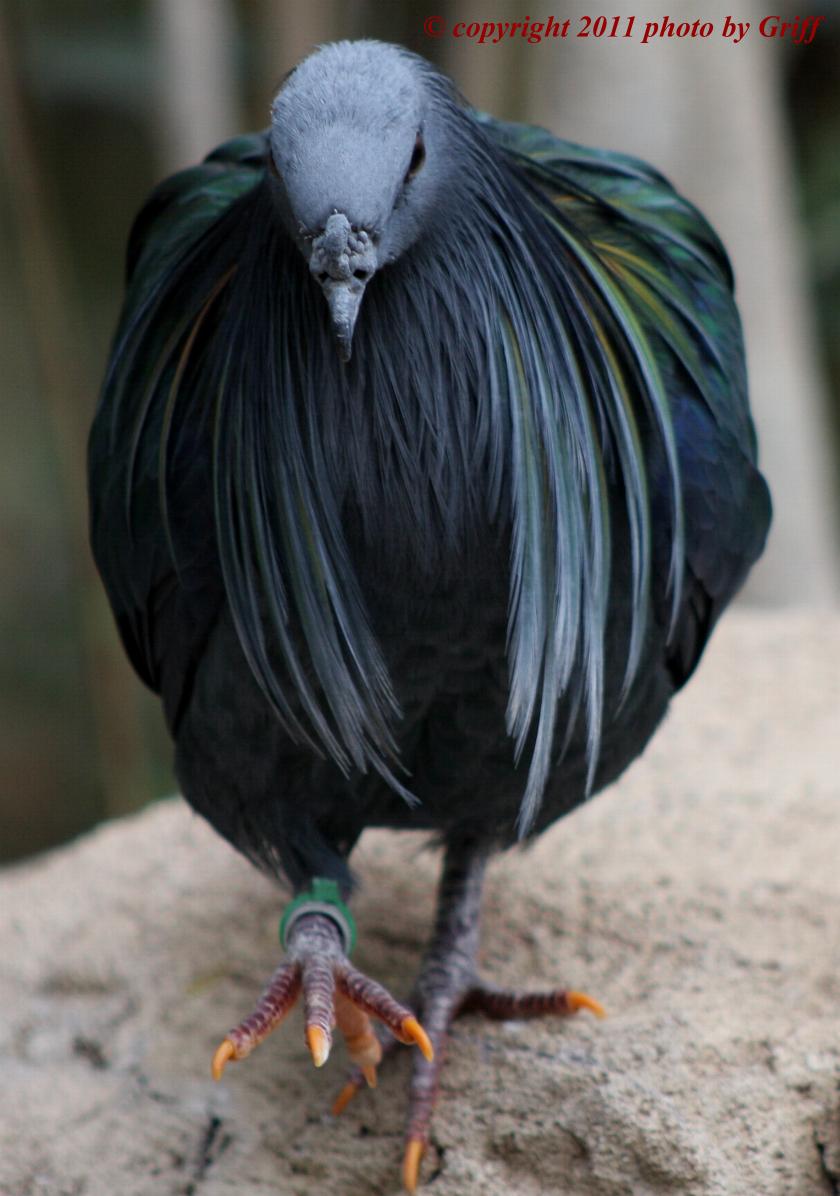
Pigeon (Nicobar) long head dress


The Nicobar Pigeon, is found on the Nicobar Islands in India. The Nicobar pigeon is one of the most beautiful of the many species of pigeons or doves. Like all pigeons, the Nicobar pigeon is rather thick-set with a relatively small head, but is heavier than most pigeons the same size. It is not a very vocal species, giving a low-pitched repetitive call. (Animal Kingdom, Disney)

Pigeon (Nicobar)


The Nicobar Pigeon is found on the Nicobar Islands in India. The Nicobar pigeon is one of the most beautiful of the many species of pigeons or doves. Like all pigeons, the Nicobar pigeon is rather thick-set with a relatively small head, but is heavier than most pigeons the same size. It is not a very vocal species, giving a low-pitched repetitive call.
 
A large pigeon can be up to 40 cm in length. The head is grey like the upper neck plumage, which turns into green and copper feathers towards the breast. The breast and flight feathers are dark grey. The tail is very short and pure white. The rest of its plumage is metallic green. The pigeon has strong legs with dull red toes.


Photographed at Discovery Cove, Orlando, FL

May 2, 2011

Pheasant (Golden)


The Golden Pheasant is one of the most popular of all pheasant species kept in captivity. It is very beautiful, hardy, easy to keep and great for beginners. The Golden has been kept in captivity since as early as 1740 and perhaps was the first type of pheasant brought to North America.


There is evidence that George Washington may have kept them at Mt. Vernon! For being so well known and familiar in captivity, very little is known of their habits in the wild, in the mountains of central China.

 Although they can fly in short bursts they are quite clumsy in flight and spend most of their time on the ground. Golden Pheasants lay 8-12 eggs at a time and will then incubate these for around 22–23 days. They tend to eat berries, grubs, seeds and other types of vegetation.

Photographed at Animal Kingdom, Orlando, FL

Apr 28, 2011

Spectacled Owl

Spectacled Owls nest in tree hollows and lay 1-2 eggs, which are incubated by the female for about 5 weeks. Chicks leave the nest for surrounding branches at about 5-6 weeks, well before they can fly, but depend on their parents for up to a year once fledged.

When hunting it generally perches on an open branch, leaning forward scanning for prey and striking with surprising agility with a swift pounce to the ground or agile swoop to snatch prey from vegetation. Primarily feeds on small mammals up to the size of opossums, skunks and rabbits. (Animal Kingdom, Disney)


Owl (Spectacled)


An unsociable bird that gets it’s name from its white markings around the eyes. A nocturnal bird whose activities normally begin after dusk and will continue to dawn. They roost singly by day in trees with dense foliage and become very vocal on calm, moonlit nights.

Spectacled Owls nest in tree hollows and lay 1-2 eggs, which are incubated by the female for about 5 weeks. Chicks leave the nest for surrounding branches at about 5-6 weeks, well before they can fly, but depend on their parents for up to a year once fledged.

When hunting it generally perches on an open branch, leaning forward scanning for prey and striking with surprising agility with a swift pounce to the ground or agile swoop to snatch prey from vegetation. Primarily feeds on small mammals up to the size of opossums, skunks and rabbits.

Photographed at Disney's Animal Kingdom, Orlando, FL

Owl (Eurasian Eagle)

The largest of all known owls. The Eagle owl has prominent ear tufts and vivid orange eyes. These birds becomes paler from north to south in Asia Minor and Middle East. Size decreases East to West, and North to South.

The Eurasian Eagle-Owl’s population declined significantly during the first half of the last century through persecution, disease, and poisoning. As a result of protection, re-introduction programs, and a change in food abundance, this owl’s population is recovering in Europe.


An eagle-owl’s flight is powerful and fast with shallow wing beats and long, fast glides. This owl will also soar on updrafts. This type of flight is similar to that of buteos or soaring hawks like the Red-tailed Hawk.


Photographed at Disney's Animal Kingdom, Orlando, FL

Parrot (Yellow-napped)


The Yellow-napped Parrot is an Amazon parrot now often considered to be a subspecies of a Yellow-crowned Amazon.

It is found along the Pacific coast from southern Mexico south to northern Costa Rica. It is distinguished by its green forehead and crown and a yellow band across the lower nape and hind neck. The beak is dark grey and is paler towards the base of the upper mandible. The feet are also dark grey.
In common with many parrot species, it feeds on nuts, berries, seeds, and fruit.
 Deforestation is reducing the number of these parrots in the wild together with illegal removal of young for the pet trade. This parrot readily mimics sounds, and in captivity this includes humans, which is probably the reason it is popular in the pet trade.
Photographed at Animal Kingdom, Orlando, FL

Macaw (Hyacinth)

The Hyacinth Macaw is the largest of the Macaws.  They can grow to 40 inches in length with a wingspan of 60 inches. They have an black beak with yellow streaks on the bottom mandible.  Their beak is known to be the most powerful beak of all birds and it has the power to crack coconuts. 


Native to Brazil, Bolivia and Paraguay, in forested areas in flooded grasslands but is on the Endangered Species list. 
In the wild they live in pairs, or flocks of 10 to 30 and eat a variety of fruits, nuts and seeds, flowers, leaves, and stems of plants. 


When adult macaws choose mates, they generally bond for life. The breeding begins around age of seven and breed once a year. They lay one or two eggs, which hatch after 29 days and are independent after six months.  They are extremely gentle. 
 
Photographed at Disney's Animal Kingdom, Orlando, FL

Macaw (Green-Winged)

Green-winged Macaws are a full sized macaw that is very colourful. The head, shoulders, and breast are a deep red. The wings next to the body are greenish turning bluer on the outside edge of the wing. It has very long tapering tail feathers.

The Green wing differs in appearance from the similar Scarlet Macaw by the band of green feathers across its back. On the Scarlet there will be a broad band of yellow feathers across the back.

In the wild Green-winged Macaws are usually seen in pairs, family groups of three, or small group of up to a dozen. They are rarely seen alone. They are a social bird and enjoy the company of their flock or of a mate as well.

They are a very gentle bird that will get along with more than one person. But they are a typical macaw and can be cranky at times and may prefer only one person or only one gender.


Photographed at Animal Kingdom, Orlando, FL

Jacana (African)


The jacanas are a group of waders in the family Jacanidae, which are identifiable by their huge feet and claws which enable them to walk on floating vegetation in the shallow lakes. They are found worldwide within the tropical zone

Only the male incubates and raises the chicks, the mother has nothing to do with it after mating, in fact she what we call polyandrous meaning that she often mates with more than one male and up to four males in a season.

It is also left to the males to build the nest which he makes from leaves and other plant material and uses floating vegetation as the foundations.


Photographed at Disney's Animal Kingdom, Orlando, FL

Hornbill (Trumpeter)


Trumpeter Hornbill, is found in the savanna region of Burundi. Characterized by its signature casque on top of its black bill, the Trumpeter Hornbill is easily recognizable. The casque of the male species of Trumpeter Hornbill is larger than that of the females.

The plumage of the Trumpeter Hornbill is mostly black in color. The skin encircling the eyes of the Trumpeter Hornbill is of bright pink color. The color of the feet is black.

Trumpeter Hornbill prefers fruits as the main item of food. It flies to distant regions in search of fruit trees. A group of Trumpeter Hornbills can consist of 3 to 13 members.

Trumpeter Hornbill nests in the natural hole of a tree. The female lays 2 to 4 eggs in the concealed nest. The incubation of the eggs require a duration of 15 days. After the end of the incubation period, the baby Trumpeter Hornbill hatches in the nest and remains there until it can fly away.


Photographed at Animal Kingdom in Disney, Orlando, FL

Hornbill (Ground)


The ground hornbills are the only ground dwellers among hornbills. Hornbills are notable for their long eyelashes and rather stubby legs and toes, with broad soles and the bases of the three front toes partly fused.

Ground hornbills prefer steppes and savannas with a fairly low grass growth, which makes the search for food easier. They have very large territories of about 100 sq. kilometres.


In South Africa there has been a large decline in their numbers for a number of reasons. They are popular to use as "muti" or tribal medicine among some of the indigenous people of South Africa. The brain of a ground hornbill, if kept in a village, is reputed to bring the village luck.


Irate homeowners kill them because they will attack windows, breaking them, if they encounter their reflections. They are also vulnerable to picking up poison baits that are set out for predators.

Photographed at Animal Kingdom, Orlando, FL

Duck (White Headed)

The White-headed Duck is a blue bill, small stiff-tailed duck that breeds in Spain, North Africa, and Asia.
 
Their breeding habitat is large tracts of open water with dense stands of aquatic plants to provide cover and nesting sites. White-headed Duck dives and swim underwater for vegetable matter and are reluctant to fly, preferring to swim for cover.

This duck is considered endangered due reduction in population due to habitat loss and hunting and introducing of the Ruddy Duck
photographed at Animal Kingdom, Disney, Orlando FL

Pintail (Lesser Bahama)


Lesser Bahama Pintail is a medium-sized duck and are easily distinguishable because of its blue bill with a red spot. Their legs and feet are grey unlike others of orange or yellow. They are native to the West Indies, northern south America and occasionally spotted in the southern U.S
 
During the incubation period of three weeks the female Lesser Bahama Pintail can produce a total of nine eggs.  The life expectancy for the Lesser Bahama Pintail is 30 years and they reach their sexual maturity at the age of two.  They travel along surfaces of water to catch fish. 


Photographed at Animal Kingdom in Disney, Orlando FL

Teal (Marbeled)

This Mediterranean medium-sized duck used to be included among the dabbling ducks, but is now classed as a diving duck.

Its breeding habitat is lowland where they lay their eggs in long grass or in high trees in Spain and northwest Africa. They may lay 7 to 10 cream eggs.

The Marbled Duck is approximately 15–17 in long. Adults are a pale sandy-brown colour, diffusely blotched off-white, with a dark eye-patch and shaggy head.

These birds feed mainly in shallow water by dabbling or up-ending, occasionally diving.

This bird is considered vulnerable due to a reduction in population caused by habitat destruction and hunting.

Photographed at Disney's Animal Kingdom, Orlando, FL